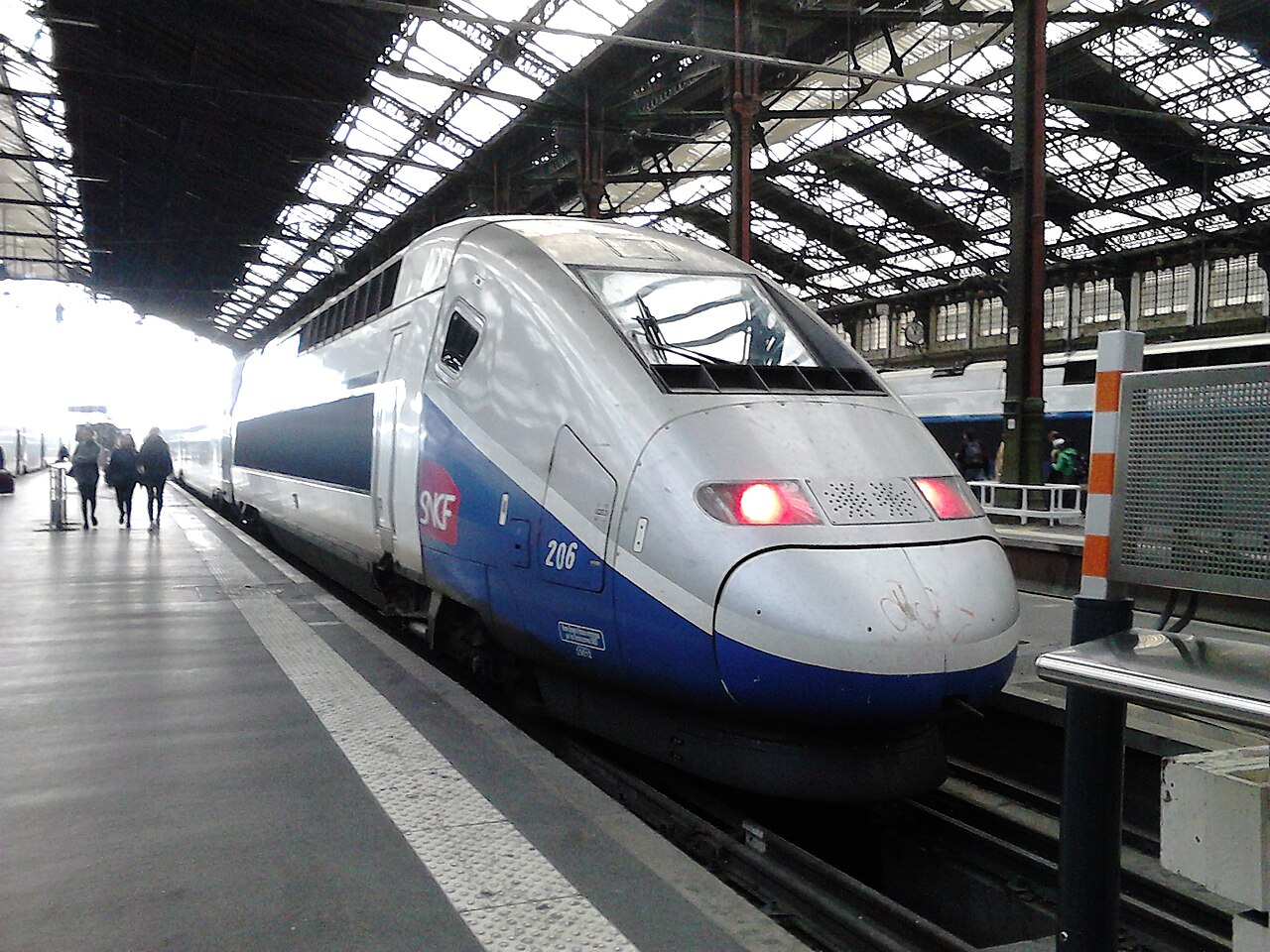
Image: Foto: Wikimedia Commons · License: cc-by-sa
Geometry of the future: the high-speed train that compresses Vietnam into 23 minutes
Geometry of the future: the high-speed train that compresses Vietnam into 23 minutes
Main source: High-speed rail, Fact Sheet | High Speed Rail Development Worldwide | White Papers | EESI, Key takeaways from the US High Speed Rail Association’s 2025 annual meeting | High Speed Rail Alliance · By The Rail Post Desk
The Hanoi–Quang Ninh line turns 120 kilometers into a commute shorter than crossing the capital at peak hour — and launches an urban model that Brazil insists on ignoring. The rails are the material geometry of the future. When Vietnam launched, on April 12, the construction of the Hanoi–Quang Ninh high-speed line, it was not just adding another railway branch to the map. It was redesigning the economic and real estate horizon of the entire northern region of the country. With a length of 120 kilometers and a top speed of 350 kilometers per hour, the new axis will reduce the current journey of over two hours to just 23 minutes. Less than the 90 minutes a resident of the capital spends to cross Hanoi at rush hour. As pointed out by expert Trân Xuân Luong in an analysis published by Le Courrier du Vietnam. The engineering behind this time leap is unequivocal. The project will use Siemens technology, likely the Velaro platform, with electric power via overhead catenary. High-floor trains in eight-car compositions with a capacity of about six hundred passengers. It is not an isolated experiment, but the adapted replication of a model that has already reconfigured Shanghai. GDP soared from 136 billion dollars in 2006 to nearly 815 billion in 2025 after the arrival of the Beijing–Shanghai high-speed train. Real estate prices around Japanese Shinkansen stations skyrocketed by 25% to 30% in the first five years of operation. The Ha Long terminal station, heart of the Vinhomes Global Gate megacity, was deliberately embedded in the center of the real estate project. A gesture that materializes the concept of Transit-Oriented Development (TOD) that urban planners around the world pursue. In Vietnam, it found political will to leave the drawing board. With the 350 kilometers per hour line, Ha Long Bay — a world natural heritage site — ceases to be a weekend getaway. It becomes a functional extension of the capital, allowing professionals to work in Hanoi and sleep by the sea. A temporal privilege whose window equals the time of a coffee. The vice-president of the Quang Ninh Provincial People’s Committee, Bùi Van Khang, defined the project as a strategic engine capable of opening new spaces for development. It consolidates the province as a growth hub to the east of the region, as highlighted by the Le Courrier du Vietnam report. By compressing 120 kilometers into less than half an hour, the train dissolves geographic friction. It creates a unified real estate market where before there were two separate universes. Repeating what Lyon experienced when the Part-Dieu neighborhood transformed into one of the five most sustainable European metropolises. With an appreciation of 30% to 40% in just three years. The Asian and European experience demonstrates that high-speed rail is not a luxury for rich countries. It is an instrument of wealth creation that rewards itself. The Beijing–Shanghai line proved this, recording more than one billion dollars in net operating profit in 2015, as documented by the Environmental and Energy Study Institute. The contrast with Brazil is embarrassing and instructive. The country that once built Brasília from scratch in three years still debates, decades after the first studies, the feasibility of a regional high-speed train between Rio and São Paulo. An axis that concentrates the highest economic density in the southern hemisphere and remains a slave to congested highways and expensive air shuttles. While Vietnam, with a GDP per capita significantly lower than Brazil’s, decides to invest in catenaries and eight-car compositions to activate the eastern frontier of its capital. Brazil stumbles in endless public hearings and master plans that treat the rail as a museum piece. Ignoring that the speed of 350 kilometers per hour redefines geography and democratizes access to the territory. The choice of Siemens technology for the Hanoi–Quang Ninh line is not just an industrial catalog decision. It is the adoption of an interoperability standard that connects the country to the global railway ecosystem. While Brazil insists on fragmented solutions that increase maintenance costs and push away long-term private investment. The TOD model applied at the Ha Long terminal also exposes the myopia of Brazilian urbanism. Historically, train stations are treated as points of passage and not as anchors of qualified densification. Wasting the opportunity to capture real estate appreciation to finance the operation of the system itself. The annual meeting of the US High Speed Rail Association in Washington, detailed by High Speed Rail Alliance, reinforced the diagnosis. The private sector only engages when there is concrete demonstration that the public sector is willing to build first. A belief that Vietnam has just transformed into a contract and that Brazil still keeps in the drawer of electoral promises. The high-speed train is not a machine of railway nostalgia. It is a vector of spacetime compression that rewrites the value of land and the organization of work on a metropolitan scale. As Shanghai and Lyon have already proven and as Ha Long is about to demonstrate. Vietnam in 2025 understood that development is not improvised with asphalt and driver apps. It is designed with catenaries, high-floor, eight cars and 350 kilometers per hour on rails that are, in fact, the material geometry of the future.