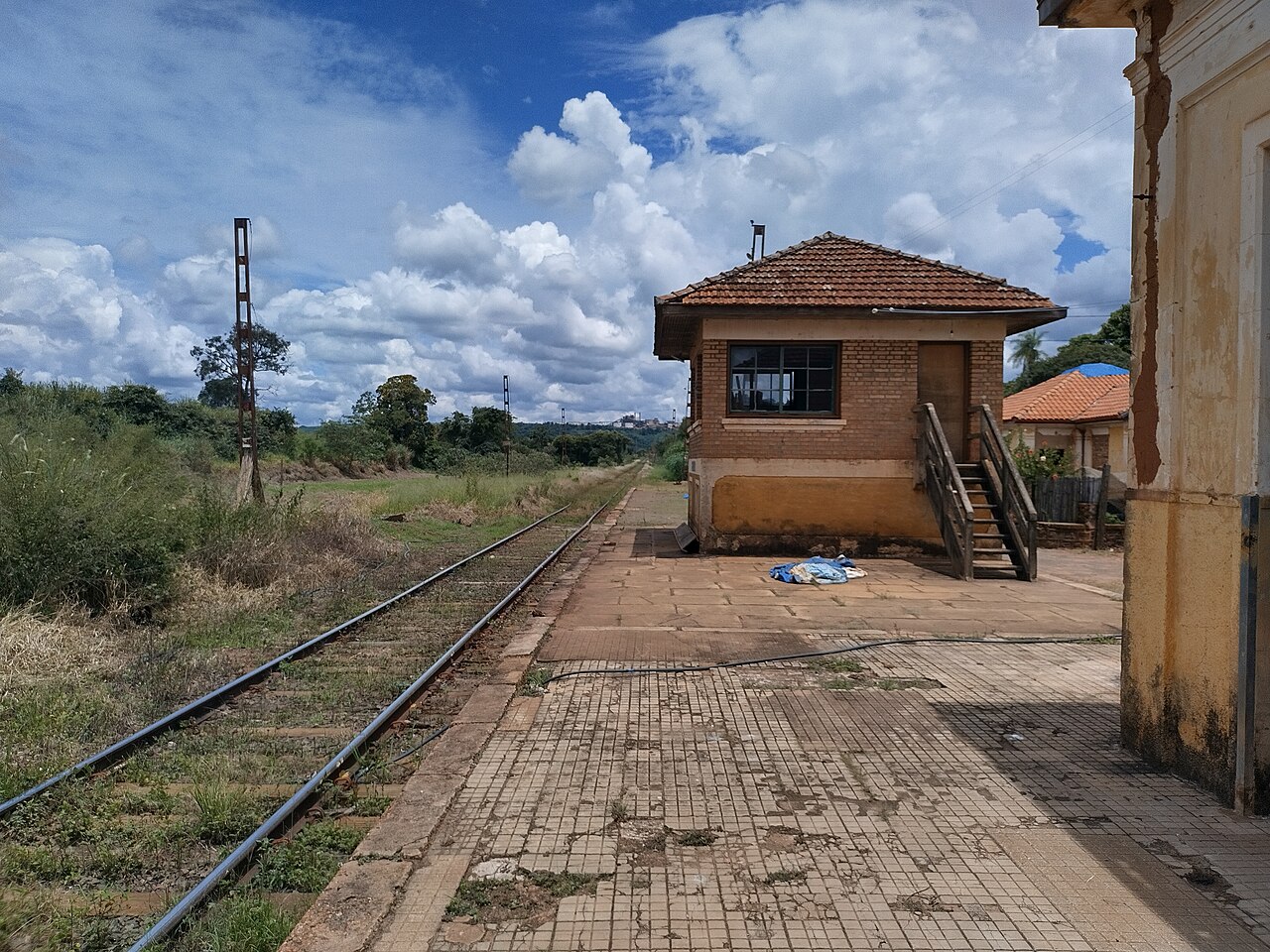
Image: Foto: Wikimedia Commons · License: cc-by-sa
The rebirth of freight railways in Brazil: FIOL as the locomotive of the New PAC
The rebirth of freight railways in Brazil: FIOL as the locomotive of the New PAC
Main source: Novo PAC garante recursos para fortalecer transporte ferroviário no Brasil — Agência Gov, Estudos e Projetos Ferroviários - INFRA S.A., Orçamento 2026 para a expansão do Metrô cresce 12% e alcança R$ 5,4 bilhões em São Paulo · By The Rail Post Desk
The resumption of works such as FIOL and the completion of the Norte-Sul redefine national logistics under the umbrella of the New PAC, breaking decades of neglect of the rail mode.
Brazil’s economic geography is beginning to be redesigned based on a vector that has been dormant for decades: the rail. It is not a return to the past, but the correction of a logistical distortion that penalizes national competitiveness. The most striking symbol of this new cycle goes by the name of the West-East Integration Railway, FIOL.
With planned investments of R$ 94.2 billion in the railway sector by 2026 through the New PAC, the Federal Government has taken on a task that the Minister of Transport, Renan Filho, defines without mincing words. “The task is not simple, since Brazil has continental dimensions, but it is extremely necessary,” stated the minister while advocating the goal of quadrupling the resources allocated to railways.
The recovery of the rail mode is not just a matter of money volume, but of administrative continuity and state planning. In 2023, after the creation of the National Secretariat of Railway Transport, the sector recorded a 4.1% growth in movement, transporting 241.6 million tons in the year’s accumulated total.
The backbone of this movement is FIOL, a railway designed to break the dictatorship of the truck in the outflow of ore from southern Bahia and grains from western Bahia. As pointed out by Agência Gov in its program details, section 1F of lot 1, with 127 kilometers, receives R$ 1.5 billion in accelerated works.
Meanwhile, FIOL’s lot 2, between Barreiras and Caetité, advances with 485 kilometers in length and already reaches 65% physical completion. The engineering complexity of this undertaking demands from the state-owned company Infra S.A. continuous monitoring and revision of the executive projects, ensuring that the infrastructure dialogues with the geology and topography of the Bahian semi-arid region.
FIOL’s relevance expands when observed together with the already consolidated network. The completion of the North-South Railway (FNS), with its 2,257 kilometers connecting Estrela D’Oeste (SP) to the port of Itaqui, in Açailândia (MA), was the logistical precondition for the west-east integration to make sense.
By connecting with FNS at Figueirópolis (TO), FIOL will form a corridor that allows products from the Center-West and Matopiba to choose between the ports of Ilhéus (BA), Itaqui (MA), or Santos (SP). This multiplicity of routes is what gives the rail mode its primary function: reducing the generalized cost of transporting low value-added cargoes, such as ores and solid bulk.
The Technical, Economic and Environmental Feasibility Studies (EVTEA) for FIOL III, with 531 kilometers between Bahia and Tocantins, are already completed, and its executive projects are ready for eventual revisions. The planning of this link, according to data from Infra S.A. itself, aims to establish an economic alternative for long-distance flows, inducing regional development and reducing dependence on the road mode.
The logic governing FIOL applies equally to the Transnordestina, another colossus of 1,200 kilometers that will cut through 53 municipalities in Piauí, Ceará, and Pernambuco to the Port of Pecém. With 60% physical progress and R$ 175 million invested in 2023 alone, the railway is intended to transport grains, fertilizers, and cement, replacing long-distance road transport in one of the regions most punished by infrastructure deficiency.
These projects confront a legacy of dismantling that dates back to the end of the Federal Railway Network (RFFSA) cycle. The Brazilian network, which once had 38,000 kilometers, shrank drastically, and the mode’s share in exports stagnated at 17% for two decades.
The Federal Government’s goal of raising this share to 40% by 2035 is not bravado, but a requirement of macroeconomic competitiveness. Every ton transported by rail instead of tire represents a saving of diesel, a reduction in highway accidents, and a relief in the freight cost that strangles the producer’s income in the interior of the country.
Numerically, the magnitude of the investment is already materializing in steel and ballast. For FIOL and the Center-West Integration Railway (FICO) alone, there is long-term planning involving a transcontinental connection to Peru, a 4,800-kilometer project whose EVTEA is at different stages of maturation at Infra S.A.
The resumption of freight rail transport in Brazil is not limited to replacing sleepers and rails, but to reinventing a financing and operation model. Under the coordination of the New PAC, the country is again looking at the logistical map with the notion that integrating the territory is the most efficient way to defend economic sovereignty and project national production into global markets.