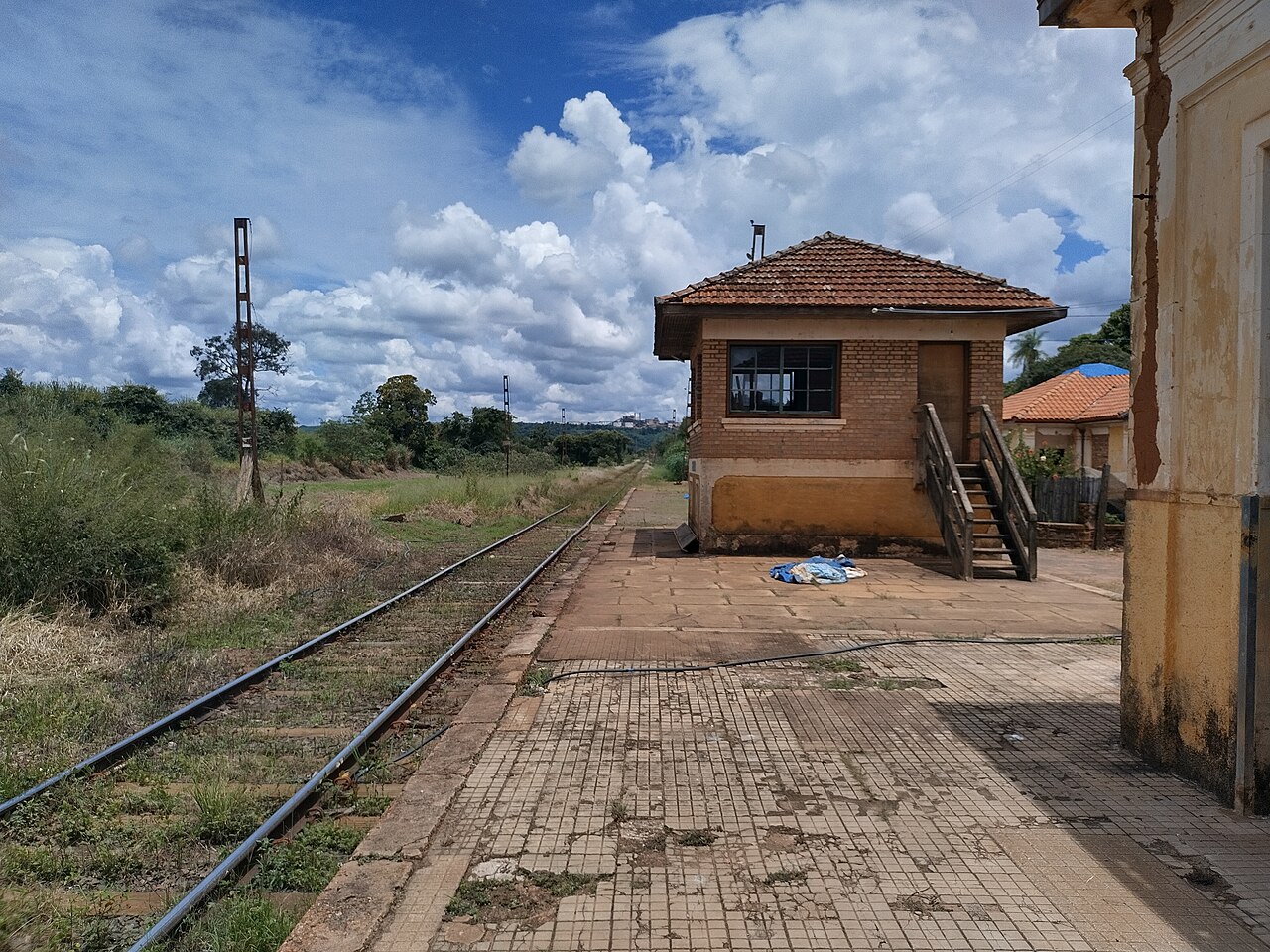
Image: Foto: Wikimedia Commons · License: cc-by-sa
American states transform freight railways into strategic infrastructure with billions in investments
American states transform freight railways into strategic infrastructure with billions in investments
Main source: These Three States Are Prioritizing Freight Rail | GoRail, Funding the Future of Rail: Innovative Tools and Partnerships Driving Rail Development — Regional Infrastructure Accelerator, Governor Hochul Announces Historic $111.1 Million Investment in Freight Rail and Port Infrastructure | Governor Kathy Hochul | New York State · By The Rail Post Desk
From Pennsylvania to Paraná, the freight rail mode ceases to be a 19th-century memory to consolidate itself as the most rational technology for economic development and logistical sovereignty.
Speed is also a form of civilization. The statement, echoing like an axiom of modern engineering, finds its most concrete translation in the ballast, rails, and marshaling yards that today drive a silent race for logistical efficiency in the United States and, still timidly, in Brazil.
Far from any railway nostalgia, the new state investments in the U.S. treat steel on rail as cutting-edge technology to solve the physical bottlenecks of the real economy, reducing the friction that drives up production costs and saturates highways with loads that don’t belong on asphalt.
Pennsylvania, the state with the highest density of freight railways in the country, has just injected $53 million into 30 strategic projects, as detailed by the GoRail portal covering the sector’s developments. The funds, channeled through the Rail Transportation Assistance Program (RTAP) and Rail Freight Assistance Program (RFAP), aim to modernize short lines and industrial spurs, creating or retaining about 450 direct jobs.
The secretary of the Pennsylvania Department of Transportation, Mike Carroll, defined the freight rail network as an asset of economic sovereignty, capable of sustaining local jobs and connecting communities to a global market that is increasingly competitive and demanding in delivery deadlines.
In North Carolina, the logic is equally surgical and averse to fiscal waste. The state’s Freight Rail Safety Improvement (FRRCSI) program released $16.3 million, which, leveraged by over $25.2 million from private partners and the port authority, resulted in a total envelope of $41.5 million.
The amount is being directed toward the modernization of over 150 kilometers of tracks (95 miles) and the structural rehabilitation of eight bridges, strengthening the resilience of vital logistical connections that take advantage of maritime-rail multimodality to flow local production without depending exclusively on truck fleets.
New York, however, raised the stakes to a record level by announcing a historic allocation of $111.1 million through the Passenger and Freight Rail Transportation Assistance Program (PFRAP). Governor Kathy Hochul, when detailing the investment package, treated the initiative as a pillar of the state’s climate and economic competitiveness, funding 38 infrastructure projects.
Among the highlights, $9 million was allocated to modernize the Port of Albany to handle heavier loads, another $5.5 million expands the Fremont Industrial Track in Queens, and $1.8 million will enable the acquisition of an electric railcar loader to reduce the carbon footprint at the Port of Oswego, a move that links logistical productivity to equipment electrification.
What these three fiscal battle fronts reveal is the rescue of the mode’s rationality. Investing in a rail yard or a new industrial spur is not a facade project, but an engineering intervention that solves the problems of ‘first-mile/last-mile,’ the so-called bottleneck of the first and last mile where logistical costs explode.
When a short line railroad connects to a main line (Class I) through a modernized spur, the entire supply chain stretches in efficiency, removing hundreds of trucks from highways and mitigating greenhouse gas emissions.
The financial engineering that makes these projects viable in the American Pacific Northwest also deserves scrutiny, as it ingeniously combines federal credit tools with public-private partnerships. The Port of Longview, in Washington state, obtained a federal loan of $35.9 million from the RRIF program (Railroad Rehabilitation and Improvement Financing) to expand its industrial rail corridor, relieving the congestion that was stifling productivity.
The Palouse River and Coulee City (PCC) railroad, also in Washington, is an emblematic case of state resilience: after the risk of abandonment in 2004, the state bought the line and articulated a monumental package involving $150 million from the state budget, a federal CRISI grant of $72.8 million — the largest ever awarded in the program’s history — and over $80 million in private capital to rehabilitate 200 miles of tracks in the agricultural interior.
The coordination among different funding layers — TIFIA, CRISI, and state subsidies — demonstrates that railway modernization is not achieved with political will alone, but with the assembly of capital structures capable of diluting risks and anticipating future revenues. In Montana, the elimination of bottlenecks on the BNSF main line, in the Malta Corridor, consumes $18.6 million to optimize the fluidity of both the Empire Builder passenger train and freight consists, proving that efficient gauge and signaling are silent prerequisites for regional GDP growth.
On the other side of the Equator, Brazil is groping with this logic through the ambitious Nova Ferroeste project. It is a 1,304-kilometer corridor that aims to connect Maracaju, in Mato Grosso do Sul, to the Port of Paranaguá, in Paraná, with a strategic branch to Foz do Iguaçu and Cascavel, according to a report by Modal Connection on state plans.
The economic model estimates that, in the first year of full operation, the new alignment will handle about 38 million tons of cargo, removing the equivalent of 357 trucks from the roads for every 100-car train consist that enters service.
With a planned investment of R$ 29.4 billion and a 99-year concession to be bid on the stock exchange, Nova Ferroeste directly echoes the American strategy of leveraging private resources to relieve the state. The crucial difference lies in the scale of the engineering challenge: the descent of the Serra do Mar requires alignment solutions that combine the ability to overcome steep gradients with environmental preservation, a technical and financial test that will require the issuance of Green Bonds to become viable.
While the U.S. fine-tunes the precision of its yards and secondary lines, Brazil has the opportunity to leapfrog stages, deploying a freight system born with intermodal connectivity as a design premise, rather than a mere late adaptation.