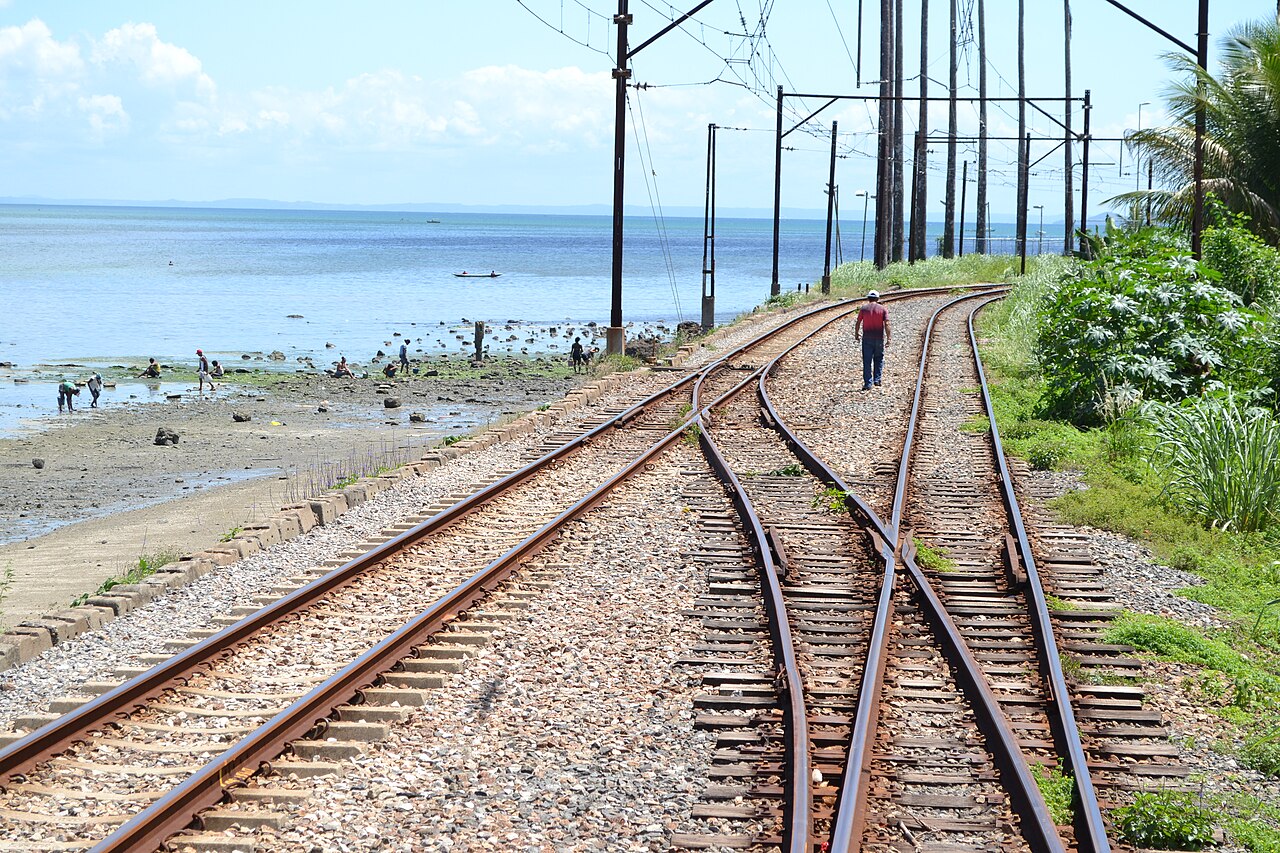
Image: Foto: Wikimedia Commons · License: cc-by-sa
Nova Ferroeste and the global leap of freight railways with PPPs and hybrid capital
Nova Ferroeste and the global leap of freight railways with PPPs and hybrid capital
Main source: Freight Rail Infrastructure Market | Global Industry Analysis & Outlook - 2036, These Three States Are Prioritizing Freight Rail | GoRail, Funding the Future of Rail: Innovative Tools and Partnerships Driving Rail Development — Regional Infrastructure Accelerator · By The Rail Post Desk
The geometry of the rails is redesigning Paraná’s Brazilian logistics and the geopolitics of grain exports.
Rails are the material geometry of the future. While saturated highways exhaust their productivity, steel on ballast stands as the most energy-efficient answer to move nations' gross domestic product.
The global freight rail infrastructure market, which reached US$42.0 billion in 2025, is projected to reach US$64.5 billion by 2036. This leap, although measured by long approval cycles, hides a structural transformation driven by public-private partnerships (PPPs) and the logistical hunger of the Global South.
According to the detailed analysis by Fact.MR, China leads the regional impetus with a CAGR of 5.2%, underpinned by the expansion of the New Silk Road corridors. Brazil emerges right behind, with a robust 4.8%, sustained by the need to transport record harvests and iron ore through heavy-haul corridors.
This is not speculative transformational growth, but rather a calculated demand. The rail mode delivers an energy consumption two to four times lower per useful tonne-kilometer, an advantage that carbon taxation makes even more competitive against trucks.
The maturation of this market requires hybrid financial engineering to overcome the high fixed capital barrier. While public ownership still holds 55% of the global market, the rail concession model and PPPs are gaining muscle as tools to enable grain corridors and intermodal yards.
It is precisely this model that fits the most ambitious greenfield project in Paraná. Nova Ferroeste, with 1,304 kilometers of rails connecting Maracaju (MS) to the Port of Paranaguá (PR) and a strategic branch to Foz do Iguaçu, was shaped under a 99-year concession and an estimated investment of R$29.4 billion.
The state rail plan detailed by Modal Connection shows that the project's engineering foresees handling 38 million tons annually. This volume will position Paraná as the country's second-largest export corridor, behind only the Carajás Railroad, which is also undergoing its own multi-billion expansion.
The practical consequence for the producer is a revolution in logistics costs, with an estimated 28% reduction in export expenses. The replacement of 357 trucks by a single train of 100 wagons redefines agribusiness competitiveness on the international chessboard.
Nova Ferroeste does not ignore the limitations of geography or green bureaucracy. The descent of the Serra do Mar was aligned with the Sustainable Development Plan of the Coast (PDS Litoral 2035), also opening the project's eligibility for issuance of Green Bonds.
This phenomenon of rail rehabilitation is not exclusive to Paraná, but a trend echoing in the Northern Hemisphere. In the United States, states like Pennsylvania recently injected US$53 million into short-line projects, focusing on industrial connectivity and preserving rural access.
Pennsylvania, which has more freight railroads than any other US state, established its development program back in 2013. Transportation Secretary Mike Carroll defended the investments as pillars of jobs and links to the global economy.
North Carolina and New York followed the same tune, with investments of US$16.3 million and US$101 million, respectively. The focus falls heavily on yard modernization, widening gauges for 740-meter trains, and consolidating intermodal corridors, reinforcing the thesis that investing in rails strengthens supply chains.
Financial innovation proves crucial at the operational tip, especially for short lines that connect the hinterland to ports. The US federal program RRIF, which offers low-cost loans, was essential for the survival of Palouse River and Coulee City (PCC), the largest agricultural short line in Washington state, which received a record injection of US$72.8 million from the CRISI fund.
New layouts, which already represent 35% of global projects, demand a look without nostalgia at the pure operation of assets. Nova Ferroeste's feasibility calculation, by separating cargo from the saturation of the South Network, is an exercise in bottleneck optimization, far from the romantic obsolescence of abandoned branches.
The participation of private capital, whether in the Brazilian cerrado or the American Pacific Northwest, paves the way for modernization without fully burdening the public treasury. The recovery of brownfield branches meets immediate demand, but it is the large projects of permanent way and civil works that ensure capturing the exponential growth of foreign trade.
Brazil, with a CAGR of 4.8%, and the United States, with 3.7%, now share the urgency of decarbonizing freight without losing cargo capacity. The density of soybeans, corn, and meal demands a heavy engineering response that asphalt can no longer offer without systemic collapses.
The Nova Ferroeste Railway thus presents itself not as a mere regional work, but as the geometric materialization of a country that is once again moving on rails. The wait for the auction and full operation will determine the speed at which Brazil will convert its agricultural potential into real profit at Atlantic ports.