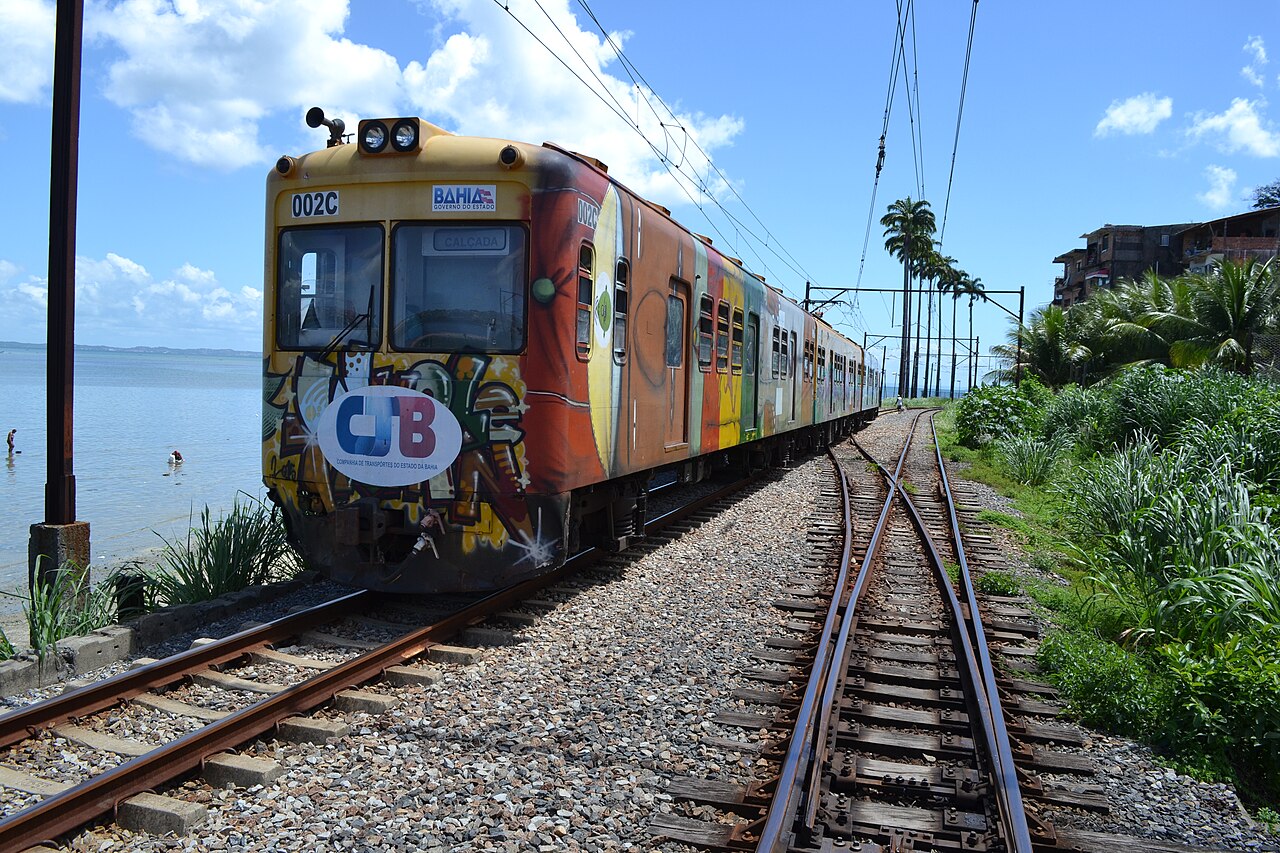
Image: Foto: Wikimedia Commons · License: cc-by-sa
The country rediscovered on rails and the transcontinental leap that China has already financed
The country rediscovered on rails and the transcontinental leap that China has already financed
Main source: Brasil e China firmam parceria que prevê ferrovia ligando Atlântico e Pacífico | G1, Brasil tenta, de novo, expandir as ferrovias. Mas ainda falta combinar com os chineses, Projetos de trens de passageiros avançam no Brasil, mas ainda enfrentam desafios - Revista Ferroviária · By The Rail Post Desk
Brazilian geography is finally being shaped by a new railway ambition, while the Pacific approaches the Atlantic with engineering, state capital and commodities.
Every great city reveals its intelligence by the way it moves people, but the intelligence of an entire nation is measured by how it moves its cargo. Brazil has belatedly decided to reopen the map and tackle the logistical equation that has been haunting it since the abandonment of rails in the 1950s.
The resumption of cargo railways in the country gained in 2026 a simultaneous and ambitious package of eight auctions, totaling 9,000 kilometers and projected R$140 billion. It is the most concrete attempt to correct a historical distortion that concentrated the movement of wealth on saturated highways, while the railway network shrank and specialized in very few products.
The reality of Brazilian rails is brutal and narrow: 73% of national rail transport in 2025 was iron ore, as detailed by InvestNews. Vale alone moved 301 million tons, operating in a vertically integrated network model in which the same company extracts, transports and ships the commodity.
Outside mining, Rumo stands out by carrying grains from the Center-West to the port of Santos, but agribusiness accounted for a modest 19% of the tonnage transported on rails. The gap between railway capacity and Brazilian agricultural production is what drives the current project portfolio, which aims to shorten the distance of commodities to ports.
The most symbolic and controversial project of this new wave is Ferrogrão, planned to connect Sinop (MT) to Itaituba (PA) over 1,700 kilometers. The line, stalled by environmental disputes since 2014, advances as a promise to create an intermodal corridor capable of changing the flow of grains through the Northern Arc.
In parallel, the East-West Corridor stitches together two railways under construction, the Center-West Integration Railway (FICO) and the West-East Integration Railway (FIOL). The idea is to connect producing areas of the Center-West directly to the ports of Bahia, bypassing the saturated Southeast axis.
The math, however, imposes a harsh and inescapable realism. Each kilometer of railway in Brazil costs, on average, R$27 million, compared to only R$8 million for a highway, and the financial return can take decades.
The equation doesn't close without state financing, and it is at this point that China enters strategically. The memorandum signed between Infra S.A. and the China Railway Economic and Planning Research Institute, in July 2025, provides for studies for a transcontinental railway from Bahia to the port of Chancay, in Peru, as reported by G1.
The port of Chancay, inaugurated by Xi Jinping in 2024 and integrated into the Belt and Road initiative, is the key piece that would reduce transport time to Asia from 40 to 28 days. The Sino-Brazilian partnership lays bare a geopolitical reality: the Chinese government treats Brazil's internal logistics as an extension of its food security.
The Chinese state-owned company Cofco is already one of the largest exporters of Brazilian soy to China, while construction companies like CCCC evaluate railway auctions and CRRC prepares a factory in Araraquara (SP). Brazil does not need to formally join the New Silk Road because physical integration is already underway, driven by contracts, bids and concrete commodity needs.
The challenge, however, lies in the details of financing and feasibility. BNDES articulates a special line for railways with extended terms of up to 60 years and a grace period during works, recognizing that private investment alone will not cover the R$140 billion of the package.
The North-South Railway, the backbone linking Açailândia (MA) to Estrela d'Oeste (SP), will also be extended to Barcarena, in Pará, integrating into a new port terminal. It is the construction of a network that, for the first time in decades, thinks of the territory as a planned logistical chain.
The bet on rails carries the weight of correcting the aberration of a continental country that abandoned intermodality and became hostage to trucks. Each new railway stretch shifts tons of grains and ores off the highways, reducing the "Brazil cost" and carbon emissions per ton transported.
The partnership with China offers scale and capital, but also imposes a debate on sovereignty and technological control. At stake is not just the route of Ferrogrão or FICO/FIOL, but the country's capacity not to repeat the cycle of building export infrastructure without internalizing engineering and innovation.
The next auctions, starting in September 2026, will tell whether the transcontinental ambition can overcome bureaucracy, the cost of steel and market distrust. Brazil has already wasted a century without expanding its rails, and the Pacific has never been so close.