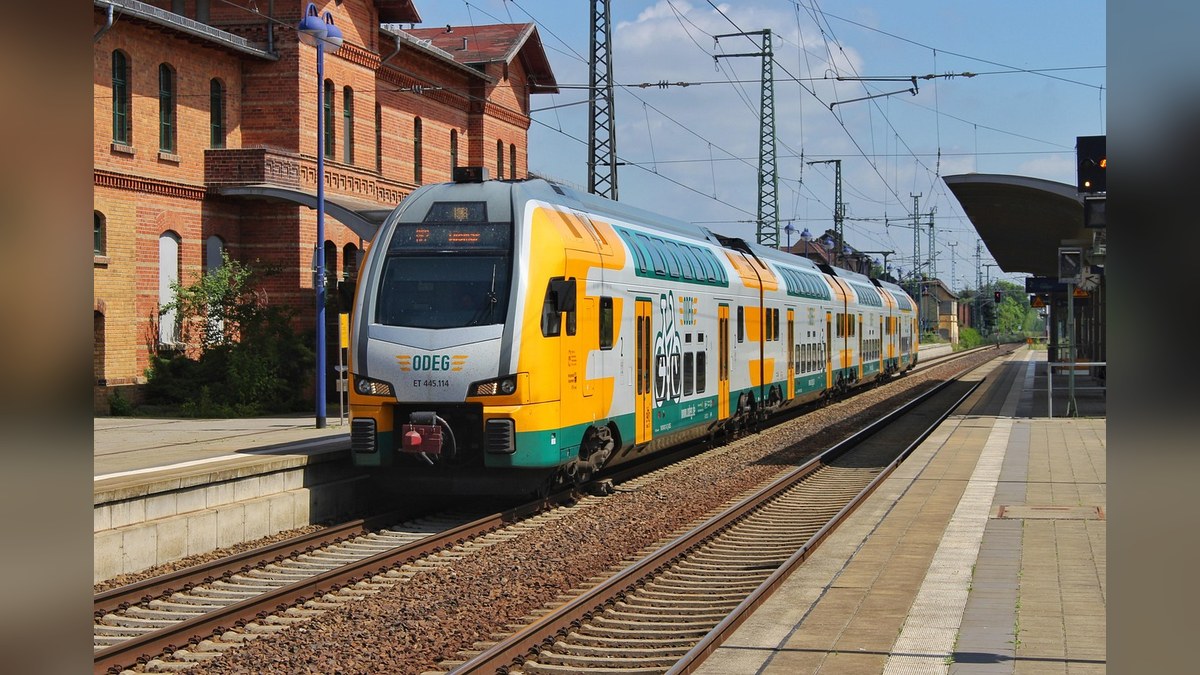
east german railway, transport, multiple unit, regional train, odeg, stadler, rail transport, regional transport, railcar, railroad, platform, private railway, stadler kiss, lübbenau, station, passenger traffic, brandenb
Image: Photo by jonasreichard on Pixabay
Stadler ETR300 trains enter service on Circumvesuviana network
First custom-built Stadler ETR300 EMUs begin passenger service on EAV's Circumvesuviana railway around Mount Vesuvius.
Main source: Custom-designed Stadler trains enter service around Mount Vesuvius · By Rail Post Desk
The first of Stadler’s custom-built ETR300 electric multiple-units entered commercial service on regional transport operator EAV’s 950 mm gauge Circumvesuviana network on July 28, operating on the Napoli – Volla – Baiano route.
The new trains ‘combine high standards of comfort with state-of-the-art technology, marking an important step forward in our commitment to improving the quality of our services’, head of EAV Pietro Diamantini told Railway Gazette International. ‘Their introduction reflects our determination to respond ever more effectively to passengers’ needs, placing customers at the heart of our development strategy.‘
Fleet renewal
Diamantini said the entry into service of the first train marks the beginning of a long-awaited fleet renewal programme.
In May 2021 EAV awarded Stadler an eight-year framework agreement covering the supply of up to 40 three-car 1.5 kV DC EMUs for the Circumvesuviana network and the provision of five years of maintenance. There was an initial firm order for 23 units. The remaining 17 units were ordered in July 2022.
A second framework agreement covering up to 60 more EMUs was signed in July 2023, with a firm order for 16 financed through Italy’s National Recovery & Resilience Plan.
The three-car aluminium-bodied EMUs are 40.9 m long, with a continuous rating of 1 080 kW, a maximum speed of 100 km/h and a capacity of 377 passengers including 90 seated.
The trains are being manufactured at Stadler’s Valencia plant. The first set was delivered to Napoli in September 2024 and officially unveiled the following month. Dynamic testing on the network began in January 2026, and the entry into service follows the granting of authorisation by the safety agency ANSFISA.
The operator has now taken delivery of 12 units, which are expected to be in service by the end of 2026.
Shunting locomotives
A contract for Bertolotti to supply eight shunting locomotives has also entered into force.
The €24.4m contract was originally awarded in July 2025, but implementation was delayed by a legal challenge. EAV confirmed in July 2026 that the contract has now become effective.
The order include locomotives for both the 950 mm gauge Circumvesuviana network and EAV’s standard gauge lines.
Circumvesuviana network
The 142 km Circumvesuviana network carries around 26 million passengers/year across its six routes serving 96 stations in the Napoli area and parts of the provinces of Salerno and Avellino.
EAV also owns and operates the Napoli – Caserta – Piedimonte Matese and Napoli – Benevento MetroCampania NordEst lines, the Metro Arcobaleno line between Piscinola and Aversa Centro, and the Linee Flegree suburban network comprising the Cumana and Circumflegrea lines. It also operates an extensive regional bus network and the Funivia del Faito cable car.
A governance reform on July 14 saw EAV’s former three-member board replaced by a new structure with Diamantini appointed as Sole Administrator, an Italian legal position when one person holds the authority to run the organisation.
Diamantini succeeded Umberto De Gregorio, who had headed EAV since 2015.
Diamantini previously held a series of senior management positions at national passenger train operator Trenitalia, including responsibility for the Frecciarossa high speed business.
The fleet renewal forms part of a broader programme to modernise the Circumvesuviana network, he told Railway Gazette International. ‘This includes the introduction of a timetable better aligned with customer demand, together with the gradual modernisation of the infrastructure. These initiatives are designed to deliver greater reliability, efficiency and overall service quality.’